From the Chef’s Writing Desk
There is an old and completely unreliable legend that somewhere in the Austrian countryside there once existed a secret society devoted entirely to Pork Schnitzel.
Not eating it.
Protecting it.
According to folklore, these men traveled village to village carrying cast iron skillets beneath long wool coats, intervening whenever someone attempted to fry pork improperly. They arrived silently at dusk. Corrected oil temperatures. Critiqued breadcrumbs. Disappeared before morning.
Personally, I choose to believe this is true.
Because Pork Schnitzel inspires the kind of devotion normally reserved for religion and vintage tractors.
The first clue is always the sound.
A proper schnitzel doesn’t merely fry.
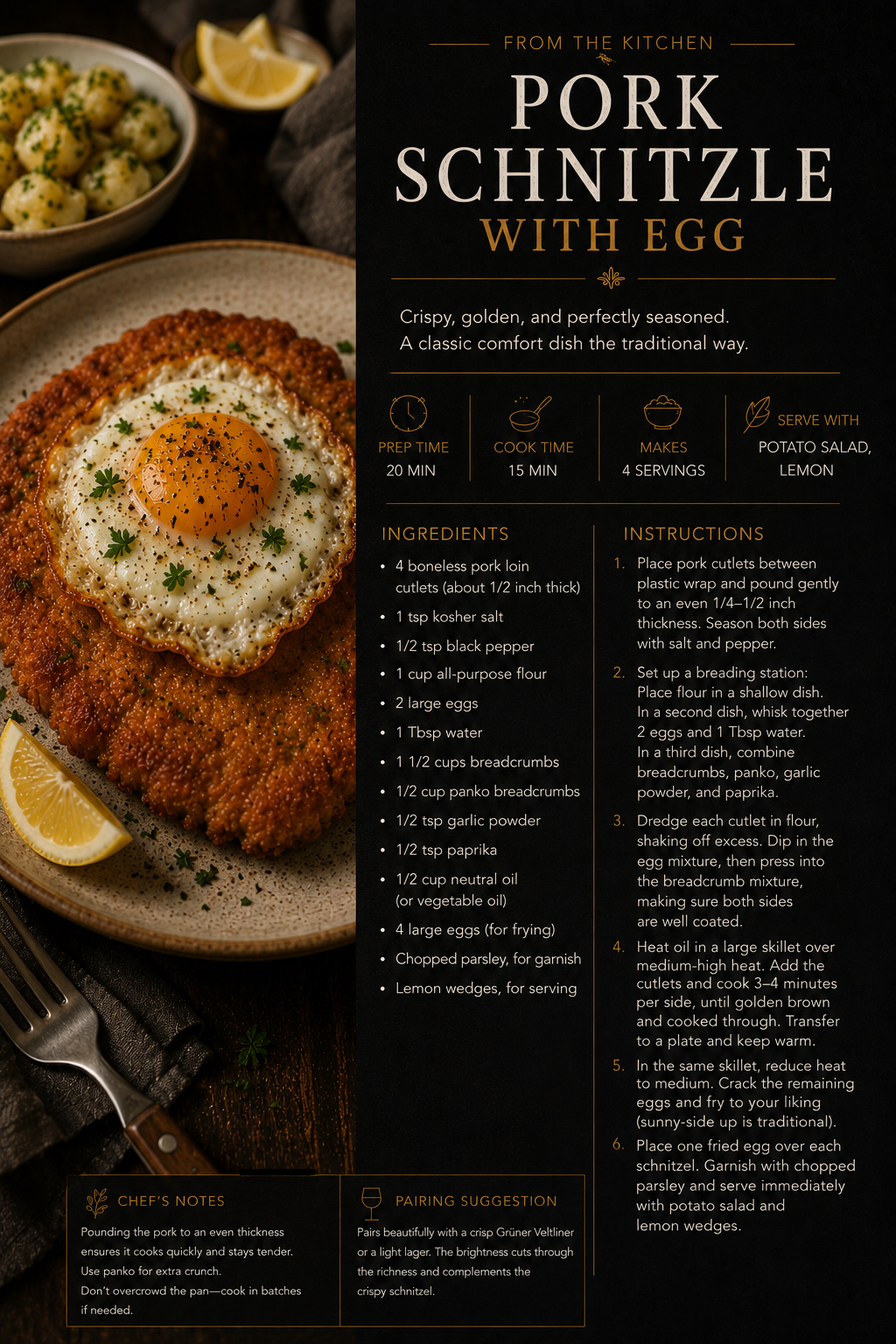
It announces itself to the household with a triumphant crackling hiss like applause from a tiny buttery audience living inside the skillet. The crust blisters and ripples. Lemon waits nearby like a supporting actor who knows exactly when to enter the scene.
Making it feels less like cooking and more like participating in a mildly dangerous ceremony.
Flour on the left.
Egg wash in the middle.
Breadcrumbs everywhere else somehow.
No matter how organized you begin, schnitzel eventually transforms the kitchen into the aftermath of a carbohydrate explosion. There will be fingerprints on cabinet handles. Breadcrumbs in mysterious locations. One lone lemon wedge discovered hours later in a completely unrelated room.
This is the law of schnitzel.
And then there’s the pounding of the pork itself.
No culinary process makes a person feel more like an old-world blacksmith preparing food for tiny medieval kings. Somewhere between the second and third cutlet, every cook begins having unreasonable levels of confidence.
You stop measuring things.
You start saying phrases like:
“That one’s got good color.”
Nobody knows what this means.
Yet somehow it feels important.
By the time the schnitzel finally reaches the plate golden, crispy, absurdly large, glistening beneath a squeeze of lemon, it no longer feels like dinner. It feels like a reward for surviving something together.
Perhaps that’s why schnitzel belongs to that rare category of food that improves storytelling immediately. Nobody calmly discusses schnitzel.
People recall schnitzel with dramatic hand gestures.
“Oh the crust on that one”
“You should’ve heard the crunch.”
“That pan nearly killed me.”
And somehow every retelling becomes slightly less believable.
Which feels appropriate.
Because Pork Schnitzel is not a subtle food.
It is a gigantic fried declaration that life is short and butter is wonderful.
— Chef Dave Trosko